

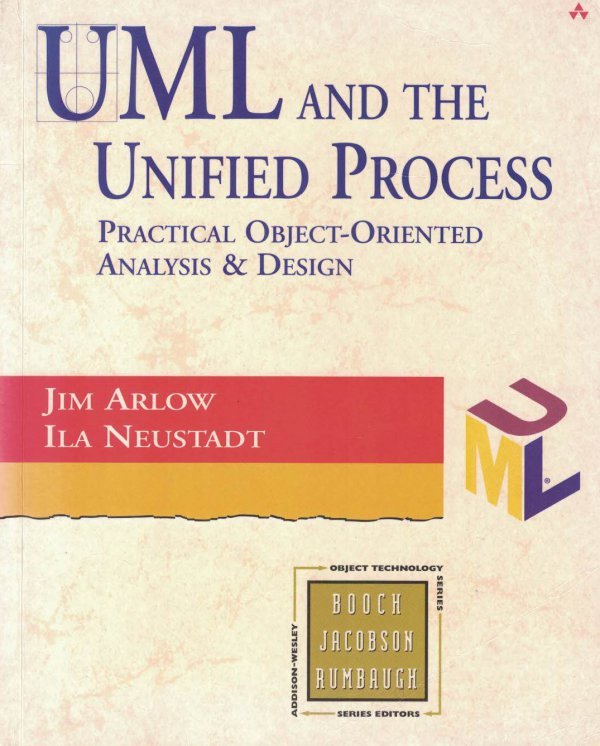
Jim Arlow
UML and the Unified Process
Náučná pre dospelých
výpočtová technika
Jazyk:anglický
395 strán
Nakladateľ : Addison - Wesley
Rok vydania : 2002
V knižnici od : 17.8.2022
Výpožičiek : 0
Stav :
Výška/šírka : 23.5x18.7 cm

UML and the Unified Process
Jim Allow and Ila Neustadt
This book provides an indispensable guide to the complex process of object-oriented analysis and design using the Unified Modeling Language (UML). It describes how the process of 00 analysis and design fits into the software development life cycle, as defined by the Unified Process (UP).
UML and the Unified Process contains a wealth of practical and useful techniques that can be applied immediately. You will learn 00 analysis and design techniques, UML syntax and relevant aspects of the UP as you progress through the text. It also provides an accessible, accurate and succinct summary of both UML and UP from the point of view of the 00 analyst and designer.
This book provides:
• Chapter roadmaps, detailed diagrams and margin notes allowing a rapid overview, enabling you to focus on your needs
• Outline summaries for each chapter, making it ideal for revision, and a comprehensive index so that the book can be used as a reference.
The accompanying website provides:
• A complete worked example of a simple e-commerce system
• Useful links to Open Source and proprietary software.
www.umlandtheunifiedprocess.com
About the authors:
Jim Arlow has been programming and designing object-oriented systems since 1990 and during this time he has created object models for companies such as Mannesmann and British Airways. He is a respected 00 consultant in Europe and has written and delivered many training courses which are given regularly in London, Frankfurt and Zurich. Jim is a regular speaker at conferences such as Object World and has been an invited speaker at City University and the British Computer Society.
Ila Neustadt has worked in British Airways’ IT department for 18 years and during this time has had experience of all parts of the IT development life cycle. She developed BA’s data quality methodology and analyzed and formalized the company’s approach to developing business and system architectures.
Find more information about the Object Technology Series at www.aw.com/cseng/otseries
ÚRYVOK :
30 Introducing UML and UP • planning; • analysis and design; • construction; • integration and test; • an internal or external release. Each iteration generates a baseline that comprises a partially complete version of the final system and any associated project documentation. Baselines build on each other over successive iterations until the final finished system is achieved. The difference between two consecutive baselines is known as an increment - this is why UP is known as an iterative and incremental lifecycle. As you will see in Section 2.8, iterations are grouped into phases. Phases provide the macrostructure of UP. 2.7.1 Iteration workflows UP has five core workflows. In each iteration, there are five core workflows that specify what needs to be done and the skills needed to do it. As well as the five core workflows there will be other workflows such as planning, assessment and anything else specific to that particular iteration. However, these are not covered in UP. The five core workflows are: • requirements - capturing what the system should do; • analysis - refining and structuring the requirements; • design - realizing the requirements in system architecture; • implementation - building the software; • test - verifying that the implementation works as desired. Some possible workflows for an iteration are illustrated in Figure 2.5. We will look at the requirements, analysis, design and implementation workflows in more detail later in the book (the test workflow is out of scope). Although each iteration may contain all of the five core workflows, the emphasis on a particular workflow depends on where the iteration occurs in the project lifecycle. Breaking the project down into a series of iterations allows a flexible approach to project planning. The simplest approach is just a time-ordered sequence of iterations, where each leads on to the next. However, it is often possible to schedule iterations in parallel. This implies an understanding of the dependencies between the artefacts of each iteration, and requires an approach to software development predicated on architecture and modeling. The benefit of parallel iterations is better time-to-market and perhaps better utilization of the team, but careful planning is essential.
30 Introducing UML and UP • planning; • analysis and design; • construction; • integration and test; • an internal or external release. Each iteration generates a baseline that comprises a partially complete version of the final system and any associated project documentation. Baselines build on each other over successive iterations until the final finished system is achieved. The difference between two consecutive baselines is known as an increment - this is why UP is known as an iterative and incremental lifecycle. As you will see in Section 2.8, iterations are grouped into phases. Phases provide the macrostructure of UP. 2.7.1 Iteration workflows UP has five core workflows. In each iteration, there are five core workflows that specify what needs to be done and the skills needed to do it. As well as the five core workflows there will be other workflows such as planning, assessment and anything else specific to that particular iteration. However, these are not covered in UP. The five core workflows are: • requirements - capturing what the system should do; • analysis - refining and structuring the requirements; • design - realizing the requirements in system architecture; • implementation - building the software; • test - verifying that the implementation works as desired. Some possible workflows for an iteration are illustrated in Figure 2.5. We will look at the requirements, analysis, design and implementation workflows in more detail later in the book (the test workflow is out of scope). Although each iteration may contain all of the five core workflows, the emphasis on a particular workflow depends on where the iteration occurs in the project lifecycle. Breaking the project down into a series of iterations allows a flexible approach to project planning. The simplest approach is just a time-ordered sequence of iterations, where each leads on to the next. However, it is often possible to schedule iterations in parallel. This implies an understanding of the dependencies between the artefacts of each iteration, and requires an approach to software development predicated on architecture and modeling. The benefit of parallel iterations is better time-to-market and perhaps better utilization of the team, but careful planning is essential.