

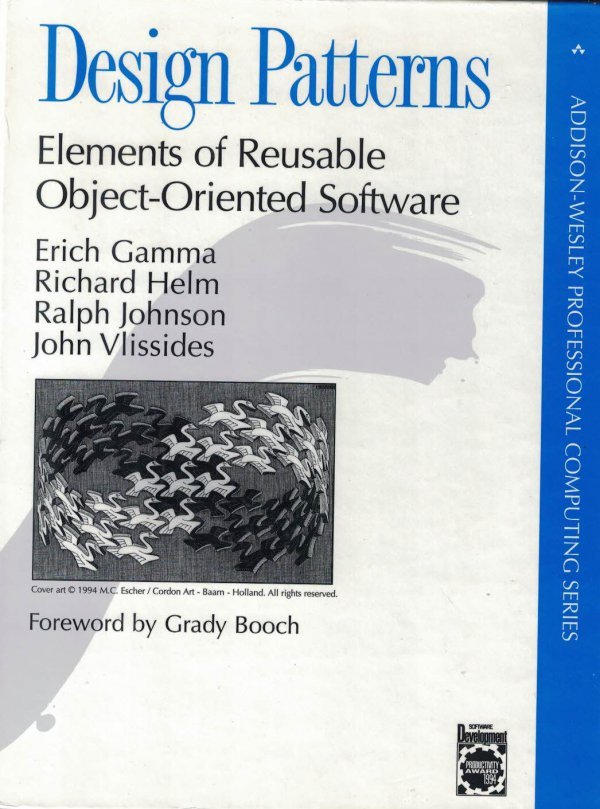
Erich Gamma
Design Patterns
Náučná pre dospelých
výpočtová technika
Jazyk:anglický
395 strán
Nakladateľ : Addison - Wesley
Rok vydania : 2014
V knižnici od : 17.8.2022
Výpožičiek : 0
Stav :
Výška/šírka : 24.1x19.2 cm

Object-Oriented Technology
Design Patterns
"This book is an important contribution to practicing object designers and developers! Have you ever tried to describe an idea that you don't have a precise name for? It can be frustrating. Design Patterns organizes and presents a catalog of proven design idioms for structuring, creating, and manipulating objects. Most importantly, it names these design constructs, allowing teams to share a common vocabulary."
— Rebecca J. Wirfs-Brock, Director, Object-Technology Services, Digita/k
"Design Patterns leaves the debates about code reuse behind and shows the real key to software reuse: reusable design. You'll find yourself applying and reusing these patterns in your own designs in no time."
— Steve Vinoski, Software Architect
“...{Design Patterns} makes two important contributions. First it shows the role that patterns can play in architecting complex systems. Second, it provides a very pragmatic reference to a set of well-engineered patterns that the practicing developer can apply to crafting his or her own specific applications."
— from the Foreword by Grady Booch, Chief Scientist, Rational
Capturing a wealth of experience about the design of object-oriented software, four top-notch designers present a catalog of simple and succinct solutions to commonly occurring design problems. Previously undocumented, these 23 patterns allow designers to create more flexible, elegant, and ultimately reusable designs without having to rediscover the design solutions themselves.
The authors begin by describing what patterns are and how they can help you design object-oriented software. They then go on to systematically name, explain, evaluate, and catalog recurring designs in object-oriented systems. With Design Patterns as your guide, you will learn how these important patterns fit into the software development process, and how you can leverage them to solve your own design problems most efficiently.
Each pattern describes the circumstances in which it is applicable, when it can be applied in view of other design constraints, and the consequences and trade-offs of using the pattern within a larger design. All patterns are compiled from real systems and are based on real-world examples. Each pattern also includes code that demonstrates how it may be implemented in object-oriented programming languages like C++ or Smalltalk.
The authors are internationally recognized experts in the object-oriented software field. Dr. Erich Gamma is technical director at the Software Technology Center of Object Technology International in Zurich, Switzerland. Dr. Richard Helm is a member of the Object Technology Practice Group in the IBM Consulting Group in Sydney, Australia? Dr. Ralph Johnson is a faculty member at the University of Illinois at Urbana-Champaign's Computer Science Department. Dr. John Vlissides conducts his research at IBM's Thomas J. Watson Research Center in Hawthorne, New York.
ÚRYVOK :
INTRODUCTION CHAPTER 1 1. Design patterns are more abstract than frameworks. Frameworks can be embodied in code, but only examples of patterns can be embodied in code. A strength of frameworks is that they can be written down in programming languages and not only studied but executed and reused directly. In contrast, the design patterns in this book have to be implemented each time they're used. Design patterns also explain the intent, trade-offs, and consequences of a design. 2. Design patterns are smaller architectural elements than frameworks. A typical framework contains several design patterns, but the reverse is never true. 3. Design patterns are less specialized than frameworks. Frameworks always have a particular application domain. A graphical editor framework might be used in a factory simulation, but it won't be mistaken for a simulation framework. In contrast, the design patterns in this catalog can be used in nearly any kind of application. While more specialized design patterns than ours are certainly possible (say, design patterns for distributed systems or concurrent programming), even these wouldn't dictate an application architecture like a framework would. Frameworks are becoming increasingly common and important. They are the way that object-oriented systems achieve the most reuse. Larger object-oriented applications will end up consisting of layers of frameworks that cooperate with each other. Most of the design and code in the application will come from or be influenced by the frameworks it uses. 1.7 How to Select a Design Pattern With more than 20 design patterns in the catalog to choose from, it might be hard to find the one that addresses a particular design problem, especially if the catalog is new and unfamiliar to you. Here are several different approaches to finding the design pattern that's right for your problem: • Consider how design patterns solve design problems. Section 1.6 discusses how design patterns help you find appropriate objects, determine object granularity, specify object interfaces, and several other ways in which design patterns solve design problems. Referring to these discussions can help guide your search for the right pattern. • Scan Intent sections. Section 1.4 (page 8) lists the Intent sections from all the patterns in the catalog. Read through each pattern's intent to find one or more that sound relevant to your problem. You can use the classification scheme presented in Table 1.1 (page 10) to narrow your search. • Study how patterns interrelate. Figure 1.1 (page 12) shows relationships between design patterns graphically. Studying these relationships can help direct you to the right pattern or group of patterns.
INTRODUCTION CHAPTER 1 1. Design patterns are more abstract than frameworks. Frameworks can be embodied in code, but only examples of patterns can be embodied in code. A strength of frameworks is that they can be written down in programming languages and not only studied but executed and reused directly. In contrast, the design patterns in this book have to be implemented each time they're used. Design patterns also explain the intent, trade-offs, and consequences of a design. 2. Design patterns are smaller architectural elements than frameworks. A typical framework contains several design patterns, but the reverse is never true. 3. Design patterns are less specialized than frameworks. Frameworks always have a particular application domain. A graphical editor framework might be used in a factory simulation, but it won't be mistaken for a simulation framework. In contrast, the design patterns in this catalog can be used in nearly any kind of application. While more specialized design patterns than ours are certainly possible (say, design patterns for distributed systems or concurrent programming), even these wouldn't dictate an application architecture like a framework would. Frameworks are becoming increasingly common and important. They are the way that object-oriented systems achieve the most reuse. Larger object-oriented applications will end up consisting of layers of frameworks that cooperate with each other. Most of the design and code in the application will come from or be influenced by the frameworks it uses. 1.7 How to Select a Design Pattern With more than 20 design patterns in the catalog to choose from, it might be hard to find the one that addresses a particular design problem, especially if the catalog is new and unfamiliar to you. Here are several different approaches to finding the design pattern that's right for your problem: • Consider how design patterns solve design problems. Section 1.6 discusses how design patterns help you find appropriate objects, determine object granularity, specify object interfaces, and several other ways in which design patterns solve design problems. Referring to these discussions can help guide your search for the right pattern. • Scan Intent sections. Section 1.4 (page 8) lists the Intent sections from all the patterns in the catalog. Read through each pattern's intent to find one or more that sound relevant to your problem. You can use the classification scheme presented in Table 1.1 (page 10) to narrow your search. • Study how patterns interrelate. Figure 1.1 (page 12) shows relationships between design patterns graphically. Studying these relationships can help direct you to the right pattern or group of patterns.